Remote Monitoring & Management (RMM) tools form the invisible backbone of modern IT operations. Through lightweight agents installed on endpoints, servers, and laptops, they continuously report system health, performance, and security metrics to a central console. From that console, IT teams can deploy patches, run scripts, enforce policies, and resolve incidents — all remotely and at scale.
For businesses, RMM tools are indispensable. They automate repetitive maintenance, enable proactive monitoring, and keep operations running smoothly without the need for physical access to devices.
In many organizations, RMM agents are considered trusted within the infrastructure and security tools like Endpoint Detection & Response (EDR) or antivirus software classify these agents as necessary and trusted. Often they are pre-configured or included by default in allow lists or approved application sets. Consequently, their actions are rarely flagged as suspicious.
Their network communication on the other hand is also trusted by design. RMM agents typically maintain outbound connections to a vendor’s cloud servers or relay infrastructure. Because this management traffic is familiar within the network architecture, it’s often allowed by firewalls or network security systems by default.
This combination of elevated privileges and trust has made RMM tools an ideal infiltration point for attackers. Once inside, attackers can move seamlessly through legitimate management channels — invisible to traditional defenses.
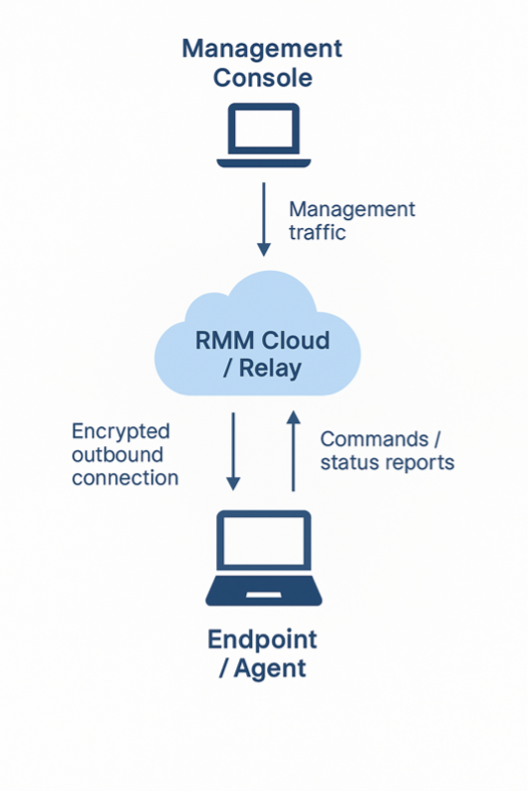
Instead of deploying visible malware that is likely to be detected, attackers compromise legitimate RMM agents or install their own disguised variants.
Because the communication channel is encrypted and blends perfectly with normal network activity, their actions remain invisible. They inherit the same administrative powers as legitimate IT operators — executing commands, spreading laterally, exfiltrating data, and disabling security controls.
This technique, often described as living off trusted software, allows adversaries to persist inside networks for weeks or even months without being detected.
RMM’s greatest strength — remote execution, persistence, and automation — becomes its biggest liability when left unchecked.
Disabling RMM is not an option. The goal is not to remove trust, but to manage it.
Below are key strategies to reduce risk while preserving the operational advantages of RMM.
RMM platforms are not inherently dangerous, but they demand a higher level of security maturity than many organizations apply.
The solution lies in redefining what “trust” means: visibility, restriction, and verification.
By monitoring what RMM tools do, limiting what they can reach, and confirming who controls them, organizations can transform RMM from an unguarded backdoor into a strategic security asset.
True security maturity isn’t about removing trust — it’s about earning it every day.
With trusted partners like Microsoft and NetSkope, synsec delivers the visibility and control needed to keep your security posture resilient — from the cloud to every device.
Ready to secure what's trusted most?
eb.cesnys@olleh or +32 494 03 28 66