Device code authentication was designed to solve a practical problem. Some devices and applications cannot easily support a normal browser-based sign-in experience. Think of shared devices, digital signage, certain IoT-style scenarios, or command-line tools where entering credentials directly is not practical.
In those situations, device code flow offers a legitimate alternative. The application shows the user a short code, the user opens a Microsoft verification page on another device, signs in there, and the original application receives the tokens it needs to continue.
That makes device code flow useful, but not harmless. In recent years, threat actors have shown that the same legitimate sign-in experience can also be turned into a phishing technique. Instead of stealing credentials through a fake login page, they trick users into completing a real Microsoft sign-in flow that authorises the attacker’s session.
For security teams, that distinction matters. This is not about a broken authentication protocol. It is about abuse of a valid one.
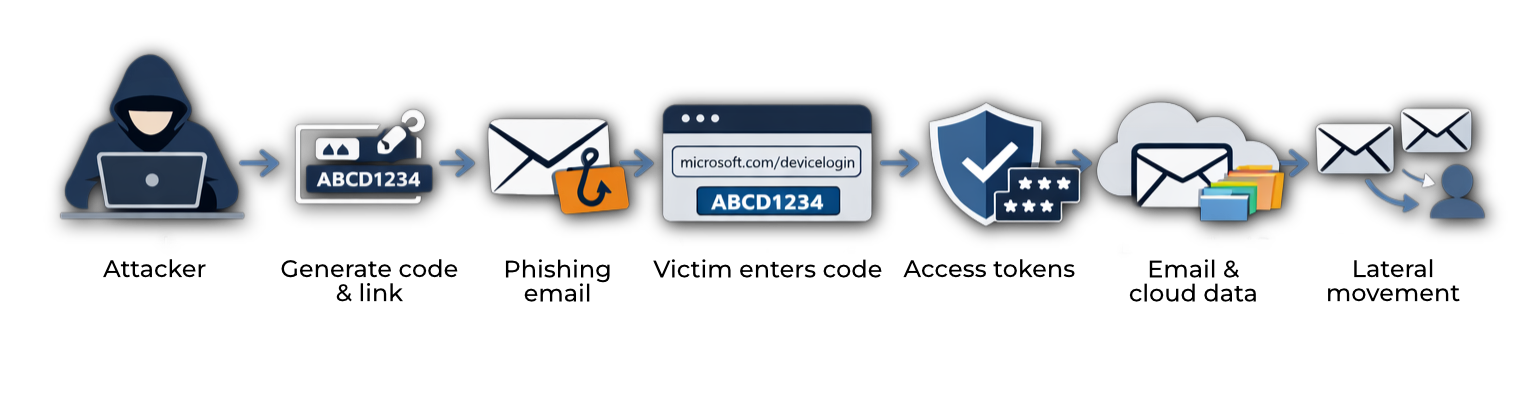
Device code flow is part of the OAuth authentication model and is intended for devices or applications that cannot present a standard interactive login screen. Rather than signing in directly on the device itself, the user completes the sign-in on a second device with a browser.
In a legitimate use case, that can be perfectly reasonable. It reduces friction for devices with limited input capabilities and enables access in scenarios where a normal web login is not practical.
From a business perspective, the flow exists for usability and compatibility reasons. It helps older or constrained workflows continue to function without forcing every device or application into a modern browser-first experience.
The problem starts when that convenience is available more broadly than the organisation actually needs.
A device code phishing attack does not usually begin with a fake Microsoft page. It begins with a legitimate device code request generated by the attacker.
The attacker then sends a phishing message that pushes the victim to enter that code on a real Microsoft sign-in page. The lure can take many forms: a meeting invitation, a collaboration request, a support scenario, or a message that appears to come from a trusted contact.
From the victim’s perspective, the experience can feel legitimate. They may see a real Microsoft URL. They may complete multifactor authentication. They may believe they are accessing a meeting, joining a collaboration platform, or validating a device.
In reality, they are authorising the attacker’s session.
Once the sign-in is completed, the attacker can obtain valid tokens and use them to access the victim’s Microsoft 365 data and other resources the user is permitted to access. That can include email, cloud data, and collaboration platforms. In some cases, the compromised account is then used for internal phishing, data collection, or lateral movement inside the environment.
That is what makes device code phishing so effective. It does not rely on a fake login page or a password prompt that users have been trained to distrust. It abuses a real sign-in process in a fake business context.
This is the part that often gets missed.
At first glance, device code phishing can sound like old news. Microsoft documented the technique, published guidance, and made defenders much more aware of it. So the obvious question is: why write about it now?
Because this was never a flaw that Microsoft simply patched away.
The issue is not that device code flow is broken. The issue is that it can be abused. As long as the flow remains available in a tenant, and as long as users can still be tricked into completing it in the wrong context, the attack path remains relevant.
That is also why Microsoft’s guidance has remained consistent: block device code flow where possible, and only allow it where there is a clear, documented operational need.
The second reason it remains relevant is that this is no longer just a single campaign story. Device code phishing has moved into the broader identity attack playbook. Once threat actors see that a legitimate authentication flow can be used to capture tokens without relying on traditional credential theft, the technique becomes attractive well beyond one specific case.
For many organisations, that creates a blind spot. Security awareness efforts often focus on fake login pages, suspicious attachments, and password theft. Device code phishing sits in a different category. The Microsoft page can be real. The MFA prompt can be real. The user can still be compromised.
That makes this a current identity governance issue, not a historical curiosity.
The most important control is also the most practical one: only allow device code flow where it is genuinely required.
For many organisations, that means starting with a simple question: do we still need this at all?
If the answer is no, blocking device code flow is usually the right move.
If the answer is yes for a small number of scenarios, then those scenarios should be documented, validated, and tightly scoped. Device code flow should not remain broadly available across the tenant just because it might one day be useful.
A sensible rollout starts with visibility. Review sign-in activity, identify where device code flow is still being used, and confirm whether those use cases are legitimate and still necessary. In many environments, this immediately reveals that the flow is barely used or only used by a limited set of operational processes.
Awareness also needs to be updated. Users should understand that a legitimate Microsoft sign-in page is not enough on its own to prove that a request is safe. If they did not initiate the process themselves, they should not enter a device code just because the page looks genuine.
Finally, response readiness matters. If device code phishing is suspected, token revocation and forced re-authentication should be part of the response plan. This is an identity attack, so containment needs to focus on sessions and tokens, not only on endpoints.
Blocking device code flow is a strong security control, but it is not impact-free.
The legitimate scenarios most likely to be affected are the exact scenarios the flow was designed for: devices with limited input capability, certain conference room systems, legacy operational workflows, command-line tooling, and some device registration or sign-in processes.
That means a blanket block without assessment can create disruption for IT operations or for niche business workflows that still depend on it.
There is also a second-order effect that security teams need to understand. Once sessions become associated with device code flow, policy enforcement can affect subsequent access attempts to other resources as well. In practice, that can result in unexpected blocks, sign-out behaviour, or troubleshooting overhead if the rollout is not properly tested.
This does not mean organisations should avoid blocking it. It means the change should be managed properly.
The right business question is not simply whether device code flow should be blocked. The right question is where it is still needed, who owns those use cases, and whether they can be reduced, modernised, or isolated.
In many organisations, the outcome will be the same: block it broadly, then create narrowly defined exceptions for the few use cases that are real, controlled, and still operationally necessary.
Device code authentication is a good example of how modern identity risk often works. The danger is not always in a vulnerability or a broken control. Sometimes the danger is in a legitimate feature that remains enabled long after its business need has faded.
That is why device code phishing still matters today.
If your organisation has not reviewed device code flow usage recently, this is a good moment to do so. Not because the story is new, but because the underlying exposure can still be present in environments that assume MFA and Microsoft-hosted sign-in pages are enough.
They are not.
Where device code flow is not needed, block it. Where it is needed, control it tightly. And where the organisation is unsure, start by measuring actual usage before making it part of the next Conditional Access cleanup.
Want to know whether device code flow is still active in your environment and what the impact of blocking it would be?
Synsec can help assess your Entra ID authentication flows and translate that into a practical Conditional Access roadmap.